Industrial soundproof curtains
Machine enclosure, dividing curtain or absorber against reverberation: how soundproof curtains cut noise in factory halls and what noise regulations require of employers.
Expert guide by Rabenring · updated 17 November 2026
In short
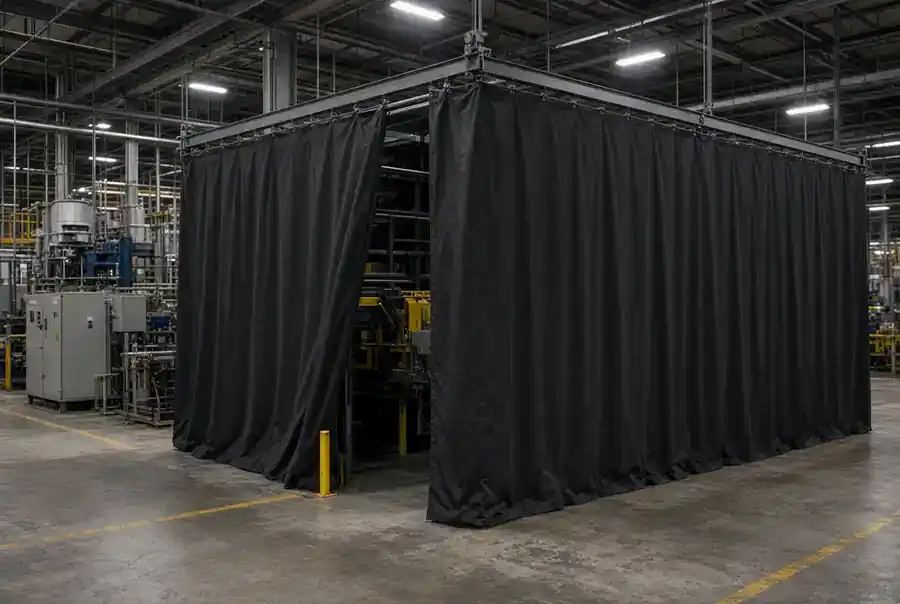
In factory halls, soundproof curtains are a technical noise control measure of the kind workplace noise regulations call for. They are used in three ways: as an enclosure around a loud machine, as a dividing curtain between loud and quiet areas, and as an absorber on walls and ceilings against reverberation. They work best when they hang close to the noise source and are combined with sound absorbing surfaces in the hall.What employers have to do
The German Noise and Vibration Occupational Safety Ordinance sets the levels at which a business must act. It is based on the EU Physical Agents (Noise) Directive 2003/10/EC, so the UK Control of Noise at Work Regulations 2005 use the same figures. What counts is the daily noise exposure level, the average over an eight hour shift, and the peak sound pressure for single impacts and bangs. Hearing protection is not deducted from these values.| Action value | Level |
|---|---|
| Lower action value, daily average | 80 dB(A) |
| Lower action value, peak | 135 dB(C) |
| Upper action value, daily average | 85 dB(A) |
| Upper action value, peak | 137 dB(C) |
Three ways to use them in a hall
Machine enclosure
The curtain surrounds the noise source on three or four sides, often on a ceiling track or a steel frame. It slides aside for maintenance and material supply. This is the most effective option, because the sound never gets into the hall in the first place.Dividing curtain
A continuous curtain splits the hall, for example between grinding and assembly or between warehouse and dispatch office. It screens off direct sound and can be opened completely when a forklift or crane needs to pass.Absorbers on walls and ceilings
Bare walls of concrete, sheet metal and glass reflect sound back. In a hall like that it stays loud even far from the machine. Curtains on the walls or as ceiling baffles absorb part of it. Under the German technical rules for workplace noise (ASR A3.7), the state of the art is reached when the hall’s average sound absorption coefficient is at least 0.3, or the level drops by at least 4 dB each time the distance doubles.What a curtain can and cannot do
A dividing curtain mainly blocks direct sound travelling in a straight line from the machine to the workstation. In a very echoey hall, though, much of the noise comes back via the ceiling and walls, over the top of the curtain. Screening then only works if sound is absorbed as well. That is why dividing curtains and absorbing surfaces usually go together. Every gap costs performance. A gap at the floor or an open section above the curtain lets more sound through than the fabric blocks. Enclosures should therefore reach the floor and overlap at the joins. Low frequencies, such as the hum of large compressors or the thud of presses, can only be dampened to a limited extent with textiles. Mass helps here: multi-layer curtains with a heavy middle layer. Where very high insulation is required, a fixed booth made of acoustic panels is the better choice. The curtain wins wherever access, space and flexibility matter. How much insulation each construction delivers is explained under do soundproof curtains work?Fabric requirements
| Requirement | What matters |
|---|---|
| Fire safety | flame retardant to DIN 4102 B1 or equivalent to EN 13501-1, with test certificate |
| Weight | the heavier, the better the insulation; multi-layer constructions with a dense middle layer |
| Durability | tear resistant hems, reinforced eyelets, lead tape or hem tube at the bottom edge |
| Environment | with oil, coolant or moisture, coated fabrics that can be wiped clean |
| Visibility | vision panels in enclosures so the machine can be watched |
How to plan noise control with curtains
- Measure: the risk assessment shows which workstations are above the action values. If this cannot be estimated reliably, the regulations require a measurement.
- Find the source: usually just a few machines determine the level. They get an enclosure first.
- Check routes: crane runways, forklift routes, escape routes and sprinklers must not be blocked. Agree this beforehand with the fire safety officer and the health and safety specialist.
- Choose the suspension: ceiling tracks for curtains that move often, steel frames for free standing enclosures, fixed cables for wall panels.
- Make it tight: down to the floor, overlapping at the joins, closed at the top up to the track where possible.
- Measure again: only the follow-up measurement shows whether the noise reduction programme has hit its target.
Typical applications
Metalworking: grinding and cutting stations, punch presses and straightening machines are enclosed so the assembly area next to them can work in more quiet. Woodworking: circular saws, planers and extraction systems are loud all day. A dividing curtain screens off benches and the office. Warehousing and logistics: conveyors, roller doors and forklifts. Curtains separate packing stations and the dispatch office from the warehouse, and wall panels dampen the echo in high racking aisles. Car workshops: impact wrenches and the compressor, between the workshop and customer reception. Labs and test rigs: mobile enclosures around pumps, centrifuges or test setups that can be taken down after the trial.Frequently asked questions
Does a soundproof curtain count as a technical noise control measure?
Yes. Noise regulations name screens and enclosures explicitly as technical measures to reduce airborne noise. They take priority over organisational measures and over hearing protection.At what noise level does an employer have to act?
From a daily average of 80 dB(A) or peaks of 135 dB(C), employers must train staff and provide hearing protection. From 85 dB(A) or 137 dB(C) they must also run a noise reduction programme and mark noise zones.How many dB does an industrial curtain block?
That depends on weight, number of layers and airtightness. A closed enclosure right at the machine works far better than a single dividing curtain in an echoey hall. Only a measurement before and after gives reliable figures.Do curtains in factory halls have to be flame retardant?
In commercial halls flame retardant fabrics are generally required, typically DIN 4102 B1 with a test certificate. The exact requirements are set by the fire safety officer and the insurer.Curtain or fixed acoustic booth?
A booth insulates more, but takes up space and makes access harder. The curtain is the flexible option for machines that need frequent access for material or staff, and for areas that change.Sources
- § 6 LärmVibrationsArbSchV: action values for noise (German)
- § 7 LärmVibrationsArbSchV: measures to avoid and reduce noise exposure (German)
- Directive 2003/10/EC on exposure of workers to noise
- Control of Noise at Work Regulations 2005 (UK)
- ASR A3.7 Noise, Annex 2: average sound absorption coefficient (German)
Soundproof curtains made to measure
Rabenring in Radeburg, Germany, makes soundproof and acoustic curtains from molton, Kalmuk and Akutex to any size, all flame retardant to DIN 4102 B1.